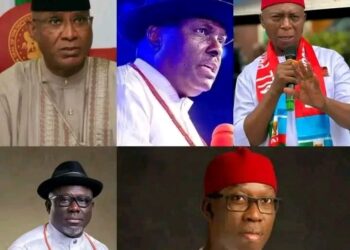





















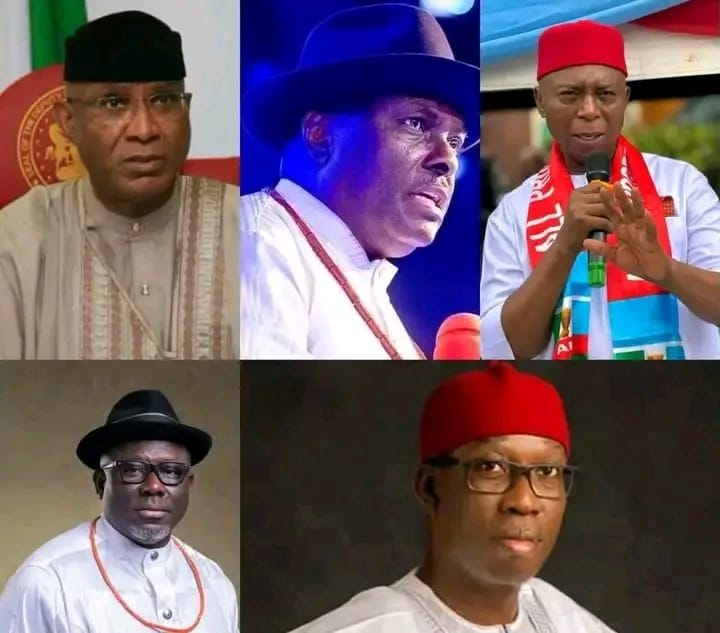

The deepening struggle for structural control of the All Progressives Congress (APC) in Delta State escalated on Wednesday as the bloc aligned with former Deputy Senate President Ovie Omo-Agege, former Governor James Ibori, and Senator Ned Nwoko — alongside what leaders describe as the overwhelming majority of the legacy APC structure — conducted parallel ward congresses across the state and produced separate executives.
The development followed a separate congress exercise organised by the camp linked to Governor Sheriff Oborevwori and former Governor Ifeanyi Okowa, whose political structure recently integrated into the APC following the governor’s defection from the Peoples Democratic Party (PDP).
Coalition Alleges Exclusion of Foundational Members
Leaders of the Delta North APC Coalition for Equity confirmed that the congress process supervised by the Oborevwori-aligned bloc allegedly sidelined longstanding party members who built the party’s grassroots machinery prior to the governor’s entry.
At a joint briefing, coalition leaders maintained that the Omo-Agege–Ibori–Nwoko tendency remains the authentic custodian of the party’s established structure. They claimed that a substantial majority of legacy ward and local government leaders participated in the parallel process they convened.
According to the coalition, foundational stakeholders were excluded from meetings where consensus lists were allegedly drafted by the new entrants.
The coalition’s Chairman, Chief Alex Ikpeazu, and Acting Secretary-General, Ken-Chad Rafua, stated that established ward leaders were neither invited nor consulted during the preparation of consensus lists presented by the governor’s political structure.
They further alleged that members who had duly purchased congress nomination forms were denied access to them, claiming forms were privately completed for loyalists of the new bloc without broad-based consultation.
Ward-Level Protests Emerge
The dispute has been reinforced by formal protests from affected wards.
In Ward 8, Umuebu, Ukwuani Local Government Area, recognised ward leaders submitted a petition rejecting what they described as an unauthorised and fraudulently altered executive list. The petitioners stated that a duly convened meeting on February 8, 2026 unanimously adopted and harmonised a ward executive list. However, they alleged that the Ward Chairman, in collaboration with Barr. Ambrose Egunatum, later altered the list by substituting and inserting names without consultation or ratification.
The signatories declared the altered list null and void and demanded recognition of the unanimously endorsed structure.
Similarly, in Ward 6, Ndokwa East Local Government Area, a petition addressed to Governor Oborevwori alleged gross misconduct and disregard for the party constitution. The petitioner, Hon. Increase Chinedu Ochonogor, stated that an initial congress list was rejected by local party leadership, leading to a fresh consensus process in which he was selected as Ward Secretary. He alleged, however, that upon arriving in Asaba to obtain his form, he was denied recognition and removed from the list over claims that he opposed former Governor Okowa’s senatorial ambition.
The petition warned that selective enforcement of party directives could undermine internal democracy and unity.
Further protests emerged in a letter signed by several ward chairmen across Delta North Senatorial District and copied to Senator Nwoko. The signatories expressed concern that the consensus process had generated “widespread unease and a growing perception of marginalisation” among longstanding party faithful.
They recalled their mobilisation efforts during the 2023 presidential election in support of President Bola Tinubu and cautioned that sidelining established grassroots leadership could weaken party cohesion and electoral preparedness.
Oborevwori Camp Insists on Due Process
Sources within the Oborevwori–Okowa camp insist their congress process was consensus-driven and in line with state party directives, rejecting allegations of exclusion and manipulation.
A Familiar Warning Sign?
The unfolding crisis presents a delicate moment for the APC in Delta State. How the party’s national leadership intervenes may prove decisive for its long-term stability.
History offers a cautionary precedent. It was sustained internal fragmentation and unresolved factional rivalries within the Peoples Democratic Party in Delta that gradually eroded its once-dominant structure. By the time the cracks became public, institutional cohesion had weakened significantly, creating the vacuum the APC eventually capitalised upon.
Today, many of the political actors central to that earlier era now occupy influential positions within the APC’s evolving structure in Delta.
The Delta APC stands at a crossroads. Whether it charts a new course anchored on inclusion and internal democracy — or inadvertently retraces the path that led to its rival’s implosion — may depend on how swiftly and judiciously its leadership responds to the current dispute.