


















By Osigwe Omo-Ikirodah
In a country where power shifts like market tides, one man didn’t just survive the transition from old politics to new politics… he mastered both. This is the story of how legacy met momentum… and refused to fade.
There is a language the streets understand better than any political theory.
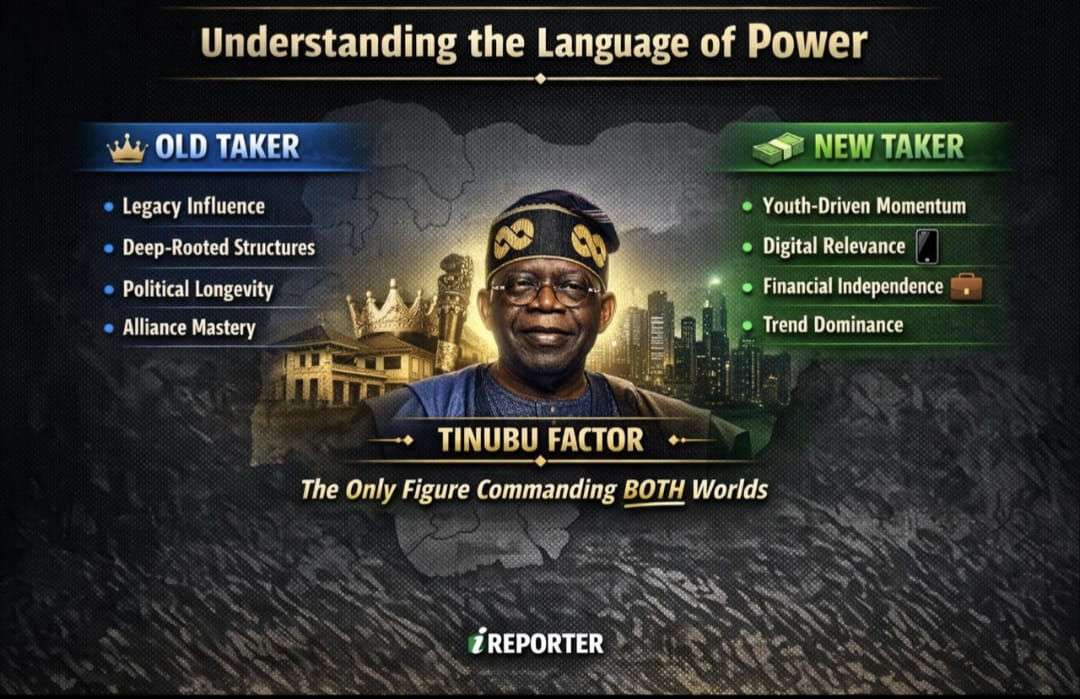
They call it Old Taker and New Taker.
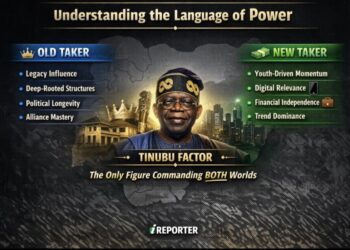
Old Taker… the original power broker. The one who has seen cycles, built alliances, and understands the silent mechanics of influence. Old money. Old structure. Old guard.
New Taker… the disruptor. The one with fresh energy, new money, digital relevance, and the loud presence of the now. The ones shaping conversations, driving trends, and commanding attention in real time.
But history rarely prepares us for the moment when one man becomes both.
That is the phenomenon of Bola Ahmed Tinubu.
Tinubu’s political journey is not a sprint. It is a long, deliberate construction. From the foundational years in Lagos where he built one of the most formidable political structures in modern Nigerian history, to his emergence on the national stage, his method has always been rooted in patience, calculation, and strategic depth.
He mastered the old system.
The alliances.
The negotiations.
The unseen levers of power.
Yet, what makes his current political relevance even more compelling is not his past… but his adaptation.
Nigeria today is governed in the age of a restless, hyper-aware generation. A generation that questions everything, trusts little, and demands results at the speed of a swipe. The rules have changed. Influence is no longer negotiated only in closed rooms… it is contested daily in the open marketplace of public opinion.
Many veterans of the old political order have struggled to find footing in this new terrain.
Tinubu did not struggle.
He recalibrated.
Rather than resist the rise of this new political consciousness, he absorbed it. Rather than dismiss the energy of younger actors, he created space for it to align with his broader structure.
The result is what we now see playing out across the country… the rise of the City Boy Movement.
This is not a conventional political machine. It is not driven by state resources or orchestrated through traditional patronage. It is a network of young, upwardly mobile Nigerians… many of them financially independent, politically aware, and strategically coordinated.
They are not waiting to inherit power.
They are participating in shaping it.
From the South West to the South South, extending into the South East and gradually gaining ground in the North, this movement represents something deeper than support. It reflects a generational alignment with a political brand that has successfully transitioned from legacy relevance to contemporary dominance.
At the same time, the traditional pillars of Nigerian politics remain firmly within Tinubu’s orbit.
Established political figures continue to align.
Governors across regions maintain strategic proximity.
Institutional structures respond to a central, coordinated influence.
This convergence is not accidental.
It is engineered.
What we are witnessing is a rare political equilibrium… where the old guard does not feel displaced, and the new generation does not feel excluded.
Instead, both are synchronized.
In local parlance, the explanation is simple:
The Old Taker has become the New Taker.
Tinubu embodies both ends of the spectrum. He is at once the custodian of long-standing political capital and the focal point of a new wave of political energy. Old money meets new money. Structure meets momentum. Strategy meets visibility.
This dual dominance is what elevates his political profile beyond the ordinary.
It is also why conversations about his legacy are beginning to shift.
Beyond electoral victories and policy debates, there is now a growing recognition of his approach as a model of political engineering… one that may, in time, be studied not just in campaign rooms, but in academic spaces.
Because when political scientists examine leadership, they do not focus solely on popularity.
They study systems.
They study control.
They study the ability to adapt and redefine the rules of engagement.
Tinubu’s career sits at the intersection of all three.
In an era where critics are louder, expectations are higher, and loyalty is more fluid than ever, sustaining relevance across generations is no small feat.
Nigeria is witnessing the rise of a political figure who did not just inherit power… but redesigned how it is acquired, sustained, and transferred across generations.
Osigwe Omo-Ikirodah is the Principal and CEO of Bush Radio Academy