






















Beware of Merchants of Empty Promises, Turncoats and Political Jobbers
By Morgan Adikwu
The final INEC list for the 2027 Benue South Senatorial election presents a crowded field, but the real question is not the number of candidates. It is who measures up in competence, legislative experience, integrity, advocacy, constituency representation, courage and measurable performance.
Among the leading contenders are Senator Abba Moro Ph.D of the PDP, David Olofu of the ADC, Francis Ottah Agbo of the APC and Daniel Onjeh of the NDC, alongside candidates of other political parties. The contest is increasingly centred on Abba Moro, Olofu and Ottah.
Senator Abba Moro has represented Benue South in the Senate and currently serves as Senate Minority Leader. His previous service as Minister of Interior and Local Government Chairman gives him both executive and legislative exposure, while his two terms in the Senate provide institutional experience in lawmaking, oversight, committees and national advocacy.
At his September 5, 2026 campaign flag-off, Moro again placed his record before the electorate, highlighting more than 100 completed constituency interventions, alongside his advocacy on insecurity, federal attention and the marginalisation of Benue South. On the 100-point scorecard, his combination of experience, advocacy, constituency knowledge and visibility gives him the clearest established advantage.
Dr David Olofu, a former Commissioner for Finance and Economic Planning and senior technical adviser, brings a technocratic and financial-management background. But among some people in Benue South, the question is what tangible impact can be traced to his years in public service, particularly in his immediate community.
His critics consequently describe him as a clout chaser, ambitious without an ancestry of performance and a merchant of empty promises. To them, his present ambition appears more focused on acquiring the title of Senator than demonstrating a compelling record of service. Whether fair or not, that perception creates a burden for Olofu to show that his ambition is backed by measurable results.
Francis Ottah Agbo brings previous legislative experience from the House of Representatives, giving him an institutional advantage over candidates without parliamentary exposure. But the Senate also demands independence, courage and the ability to speak forcefully for one’s constituency.
His recent comments concerning the minority status of the Idoma people generated reactions across the district, with critics arguing that his position does not sufficiently confront the political marginalisation being raised by Benue South stakeholders. His alignment with Governor Hyacinth Alia has similarly fuelled questions about his independence on matters affecting the district.
That perception has produced a harsher description of Ottah among his critics: a political opportunist, turncoat and a politician facing an identity crisis of principle. They point to his transition from journalism, where he previously criticised political actors, to defending interests he once attacked, arguing that he flows with the tide as it favours him, with interest taking precedence over principle.
Daniel Onjeh remains a recognisable political figure and former Senate contestant. However, name recognition and electoral visibility alone cannot substitute for current institutional advantage, demonstrated legislative capacity and sustained constituency advocacy.
The remaining candidates also face the same fundamental test, what have they done, what can they demonstrate and what capacity do they bring to the Senate? Party affiliation or political visibility cannot answer those questions.
Ultimately, Benue South voters are choosing someone who will represent Ado, Agatu, Apa, Obi, Ogbadibo, Ohimini, Oju, Okpokwu and Otukpo in the Nigerian Senate. The choice therefore requires more than slogans; it requires a measurable record and the capacity to convert a mandate into effective representation.
On the available evidence, Abba Moro enters the contest with the most complete Senate résumé: two terms of legislative experience, current Senate leadership, previous ministerial experience, constituency advocacy and a record available for public scrutiny.
Olofu’s strongest argument remains his technocratic and financial-management background, while Ottah’s principal advantage is his previous legislative experience. Both, however, must convince voters that those credentials translate into the courage, independence and effectiveness required in the Senate.
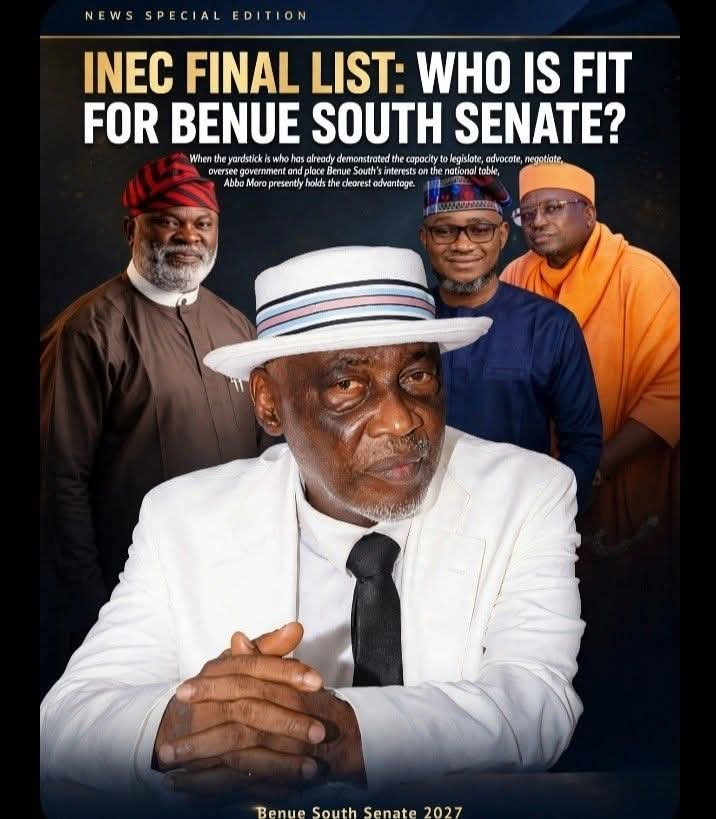
When the yardstick is who has already demonstrated the capacity to legislate, advocate, negotiate, oversee government and place Benue South’s interests on the national table, Abba Moro presently holds the clearest advantage.
The 2027 election remains the voters’ decision. But on antecedents, legislative experience, advocacy and demonstrated performance, the burden rests on the challengers to show why Benue South should replace an incumbent whose record is already open for assessment.