

















By Paul Arabome…… Canada
Nigeria at a Defining Crossroads:
Nigeria stands today at a historic junction , a nation struggling to reconcile its enormous human potential with persistent governance failures, economic distress, institutional decay, and widening generational disillusionment. The question before the Nigerian political class is no longer merely who should rule, but what kind of leadership model can rescue the idea of Nigeria itself.
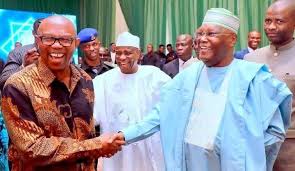
Within this context, the joint Atiku-Obi ticket, powered decisively by Atiku Abubakar’s political, and structural capital, represents more than an electoral calculation. It signals a redefinition of statesmanship, partnership that births national purpose — a showcasing of how distinct qualities can morph between Nigeria’s elite to displace a failed incumbent government.
Peter Obi as the Symbol of a New Nigerian Social Contract:
Peter Obi’s political emergence transcends party lines. His 2023 candidacy revealed something unprecedented in Nigeria’s recent history: a citizen-driven political awakening, especially among youths, professionals, urban voters, and the politically disengaged.
What Obi Represents:
• Moral Authority and Credibility.
Obi’s appeal rests not on political theatrics but on perceived integrity, prudence, and competence. In a country fatigued by grand promises and elite excess, his frugality and data-driven rhetoric offer a contrasting leadership ethic.
• Youth Mobilization and Civic Re-engagement.
The “Obidient” movement demonstrated that Nigerians — particularly the young — are willing to participate when they feel represented. This is critical for restoring faith in democracy itself.
• Issue-Based Politics Over Identity Politics.
Obi’s messaging shifts the national conversation from ethnicity and religion toward productivity, education, healthcare, and economic reform, aligning with global democratic norms.
Yet, moral clarity alone does not win Nigerian elections. This is where the Atiku factor becomes indispensable.
The Atiku Factor Reimagined: The glue that binds the Atiku-Obi ticket.
Atiku Abubakar is often assessed solely through the lens of his repeated presidential bids. But in a broader historical sense, Atiku embodies something rarer in Nigerian politics: a genuinely national political infrastructure built over decades.
What Atiku Brings to the joint Atiku-Obi ticket
• National Political Machinery.
Atiku possesses one of the most expansive political networks in Nigeria, cutting across:
Northern political elites and traditional institutions
Middle Belt power blocs
Business and donor networks. Due hard supporters with entrenched interests in top western nations.
Party structures honed over multiple electoral cycles
This machinery solves one of the most persistent challenges of the Atiku-Obi ticket: nationwide penetration, particularly in regions where Obi’s message may struggle to organically reach.
• Financial Capacity and Electoral Logistics.
Elections in Nigeria are not won on ideals alone. They require:
Massive funding,
Legal teams,
Polling-unit agents nationwide,
Election-day logistics.
Atiku’s financial capacity and access to institutional donors would shield the Atiku-Obi ticket from structural sabotage, allowing ideals to compete on an even field.
• Elite Negotiation and Power Balancing
Nigeria’s political reality still demands elite consensus-building. Atiku’s long experience positions him as a bridge between:
Reformist aspirations,
Entrenched political interests,
Regional power expectations.
Electoral Implications: A Winning National Equation
An Atiku-Obi alignment reverses the usual opposition weaknesses:
Atiku Contributes National Structures, Electoral Experience, Rural Penetration and Political Negotiation.
Obi Contributes Youth Energy, Moral Legitimacy, Urban Support Policy Clarity and the Massive very important Obidient movement unalloyed support.
This configuration significantly reduces vote-splitting, regional imbalance, and structural vulnerability — the very factors that have historically handed victory to incumbents.
Implications for the Restoration of Nigerian Nationhood
Beyond winning elections, this alliance could reset Nigeria’s political culture:
• A New Model of Leadership Succession
It would demonstrate that leadership transition can be intentional, ethical, and nation-focused, rather than chaotic or self-serving.
• Re-legitimizing the Nigerian State
When citizens see elite sacrifice for collective good, trust in institutions increases. That trust is the foundation of nationhood.
• Bridging Generational Divides
This model harmonizes:
The wisdom of the old guard
The urgency of the youth
The aspirations of the middle class
A rare convergence in Nigeria’s fractured polity.
The Choice That Defines a Generation
Nigeria does not merely need another president; it needs a national reset anchored in credibility, competence, and consensus, all of which will be found in an Atiku-Obi presidency.
Engr Paul Arabome (MSPE, MNMGS, MPI) ADC chieftain western Canada writes in from canada 🇨🇦.