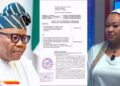






















By Sam Akpe
What is unfolding at the NDIC-Nigeria Deposit Insurance Corporation-is deeply disturbing. Except handled carefully,
the outcome could
question
depositors’ confidence in Nigerian banks.
That would also mean, by extension, indirectly questioning the required integrity, commitment, and professionalism of the Corporation in the execution of is statutory functions.
For purposes of contextual clarity, NDIC is a statutory body founded to engineer a sustained confidence in depositors over collapsed financial institutions, especially commercial banks.
That means whenever a bank goes down, NDIC, backed by legal instruments, takes over and manages both the assets and liabilities of such a bank for the benefits of the customers and partners.
By its precise nature, NDIC is expected to boost or create feelings of certainty in bank customers, as the chief custodian of Nigerian banks-being the last man standing when all else fail.
Its message should be: don’t shy away from doing business with Nigerian banks. Even if they collapse, your deposits and businesses are safe.
Unfortunately, NDIC is presently on trial following the collapse of Heritage Bank in 2024. The onus is on it to prove where its loyalty lies—whether with the bank customers and partners or with a handful of influential power wielders in government?
In the matter involving Farouk Bello Bunza and the defunct Heritage Bank, NDIC seems to have transformed into a powerful bully that is out to thunderously demonstrate strange institutional powers unknown to any legal instrument.
Its chief executive officer,
Thompson Oludare
Sunday, on December 17th, called a press conference to enable him “set the records straight” on the controversies that followed Heritage Bank’s pre-liquidation sale of an asset to Farouk.
The press conference came 24 hours after a fact-based article chronicling, questioning, and revealing circumstances that led to the hypothesis that the Corporation is being arm-twisted to raise its iron fist against Farouk.
However, at the end, it was unclear whether the CEO actually set the records straight on the burning issues in question, because he sounded more like someone stampeded into distorting the records to suit a pre-determined narrative.
That press conference compared exactly with what the comedian, Stephen Colbert said in 2016 about political deception: “You know what the facts are, but you go with what feels more truthful to you.”
It turned out to be long on grammar, but short on facts, and that has left a lot of people worried.
Anyone with access to some of the correspondences between the NDIC and Farouk on the property purchase, would easily spot big holes in the narratives offered to the media by the NDIC’s chief executive officer.
The publics’ interest in this incident is the fact that what looks like a clear case of injustice or moral degeneracy is on bold display, and it is assumed to be business as usual.
As the late Martin Luther King Jr is often cited to have said, injustice somewhere automatically translates into injustice everywhere. Today, it is Farouk. Tomorrow, it could be any of us!
The summary is this: Farouk signed an agreement to buy a property from Heritage Bank. A few months later, Heritage Bank had its license revoked. As statutorily demanded, NDIC took over the assets and liabilities of the bank.
Farouk wrote to the NDIC on the property. The Corporation acknowledged that it was aware of the pre-liquidation deal, but that based on a fresh valuation, the cost of the property had changed from N4.5 billion to more than N14 billion.
Farouk disagreed. He questioned the morality behind the change in cost even after NDIC had stated in writing that Farouk diligently executed his obligations under the agreement.
At the end—or so it was assumed-NDIC adjusted its position, based certain realities—the reduction in the market value of the property caused by a forced seizure of some parts of the property by the Lagos State Government.
Mr. Sunday confirmed this when he said:
“Subsequently, the Corporation received reports that construction and land reclamation activities were being undertaken on the adjoining property by the Lagos State government.
“This resulted in the loss of the beachfront view previously enjoyed by the subject property. This development significantly diminished the property’s market value.
“This has direct implications for properties previously affected by reclamation works, such as the instant property, which had been revalued downward owing to the loss of its beachfront view caused by nearby reclamation.”
The Purchaser,
Farouk, was thereafter given some
conditions to fulfil based on this realisation.
NDIC promised to release the title documents to him through his bank on fulfilment of those conditions, which were actually not parts of the original agreement.
Initially, Farouk was hesitant. Who would not! But he obliged at the end by paying the required amount even faster than demanded, and signing the Deed of Undertaking imposed on him by the Corporation-just before the deadline expired.
Suddenly, the Corporation retracted its previous documented commitment to Coronation Merchant Bank which financed the deal through its real estate financing facility,
claiming
that Farouk did not respond
appropriately, as demanded.
The most bizarre part of the drama was when NDIC urged Coronation Merchant Bank, which financed the agreement,
to ignore its earlier acknowledged
commitment to play by the rules by releasing the title document on the property.
Mr. Sunday told journalists that the property was
“offered on an ‘as-is’ basis, due to the legal action and the custody of the title document, which had been established to be in custody of an erstwhile director of the defunct bank.”
Wait a minute! If the title documents were not with NDIC, why did the Corporation promise their release to Coronation Merchant Bank as soon as full payment was made the property?
For avoidance of doubt, a part of the commitment dated 11 November, 2025, reads: “We write to confirm that upon receipt of the balance sum of N2,148,888,888.91 in cleared funds, we will proceed to release the title documents relating to the subject property to you accordingly.”
That letter was written by NDIC to Coronation Merchant Bank, which funded the transaction for Farouk.
This is why it is believed that the press conference by NDIC was meant to distort facts instead of setting the records straight. Why did the Corporation promise to give Farouk documents that were not in its possession?
Again, when questioned by curious journalists, the CEO said the document were not released because Farouk did not meet the conditions set by the Corporation-remember, these conditions were not part of the original agreement signed by Farouk.
Here are his words: “Following the failure/refusal of Senator Bunza’s (sic) to accept the terms of the revised offer, the Corporation wrote to Senator Bunza via letter dated November 19, 2025, informing him of its inability to accede to his request or the release of the original title documents or any related property documents as a condition for granting the financing facility.”
The question that quickly comes to mind is: has
NDIC refuse to release the title documents as promised because the documents are not in its custody, or is it because Farouk refused to meet the arbitrary terms of revised offer set by the Corporation?
Which version of the story should the public believe: that the title documents are not with NDIC, which means
NDIC deceived Coronation Merchant Bank, or that NDIC refused to release the documents because Farouk did not meet its conditions?
The Sun newspaper quoted the CEO this way: ” the title document was not among the assets taken over by the NDIC.
“Our examiners only record what they physically meet when we assume control of a failed bank. We cannot release a title document we do not have.”
This revelation on the whereabout of the title documents also begs the question: why did NDIC not come clean with this position in its dealings with Farouk since 2024 or in its dealings with Coronation Merchant Bank in 2025?
First, NDIC demanded full payment within a specified period. Second, it promised a release of title documents as soon as payment was completed, only to deny that it had the mysterious documents after Farouk had fulfilled his side of the obligation.
During the press briefing, NDIC smartly refused to mention that Farouk, through the merchant bank, actually paid the balance of the money in one day as against the original payment schedule which the Corporation gave to him.
Based on media reportage, it can be reasonably concluded that the press conference was a mere deceptive spectacle by an institution whose silence on the matter would have accorded it an assumption of innocence.
All the same Mr. Sunday’s responses to issues outlined in my previous analysis have not only confused discussions on the issue, but have equally exposed an unguarded desperation to bend facts and achieve a set goal.
The NDIC boss told journalists that the Corporation is not being arm-twisted by external influences to disregard a signed agreement or stand facts on their heads on an issue that is as straight forward as a flag pole.
That is actually difficult to believe considering how his previous statements at the same press are at variance with documented truths on the subject matter.
The Guardian newspaper presented its report under a disquieting headline: “NDIC insists Ikoyi property sale to Senator Bunza remains terminated.”
Terminated? On what grounds?
The newspaper reported the NDIC as saying that
“there is no binding sales agreement between it and Senator Farouk Bello Bunza” and that “the transaction was automatically terminated following his refusal to accept revised terms.”
Without sounding too technical, yes, Farouk had no binding sales agreement with NDIC. His original binding agreement was with Heritage Bank whose assets and liabilities—which included the agreement—were inherited by NDIC. So?
The CEO was further cited as confirming that the Corporation received
a request from Coronation
Merchant Bank seeking an undertaking to enable financing for Farouk, but that NDIC declined, citing his refusal to accept the revised terms.
That cannot be true. The above cited letter with the heading: “Re: Confirmation of Outstanding Obligation and Undertaking to Release Title Documents—Zone J, Plot 55, Federal Government Layout, Banana Island, Ikoyi, Lagos-State” contradicts that spin.
It happened that after the bank had paid the required amount on 20 November, NDIC wrote back to rescind its previous commitment to give the title documents to the bank. Here are two paragraphs of its letter dated 21st November, 2025.
“Kindly be informed that the Corporation cannot accede to your request for an undertaking to release the original title documents or any related property documents pertaining to the said property as a condition for granting the financing facility to Senator Bunza.
“This correspondence hereby formally retracts our earlier letter on the above subject, dated November 14,
2025. (Appendix 1). Accordingly, you are advised to disregard its contents, as it does not reflect the Corporation’s position on the matter.”
The above citation confirms that the Corporation had earlier accepted to release the title documents to the property, only to change its mind some hours after the payment had been made! Why?
A report by the Sun newspaper quoted the NDIC boss as further stating that: “The issue is not title (title documents pertaining to the property). We have sold properties without title before. The real issue is the outstanding sum.
“Nobody prevented him from paying. If the conditions stipulated had been fulfilled and payment
complete
completed, this matter would not have arisen.”
Really? Was the payment not made? What about the evidence that Coronation Merchant Bank actually paid for the property on behalf of Farouk, but that trouble only started when the demand for the title document was made!
There is no questioning the fact that if the NDIC were to operate in line with its legal conscience on this issue without any outside Influence Farouk case would have been settled long time ago.
NDIC seems to be exceptionally good at re-writing narratives to validate its actions and inactions which are meant to frustrate Farouk out of the deal. So far, this does not seem to be working.
What we have heard from the Corporation so far are emblematic of yarns divorced from actualities-more of self-contradicting tales or deceptive pretense that cannot survive a legal scrutiny.
NDIC is a sensitive institution, and a democratic society, such as Nigeria, can only function when citizens have faith in such bodies.
Let it be clear that any misguided persuasion to arbitrarily revoke the sale agreement NDIC inherited from Heritage Bank would be the Corporation’s dumbest option at managing the situation.
It must not be contemplated at all, because there is no reason for it. It would, at the end, amount to an exercise in avoidable reputation ruination, because agreement is agreement.
*Akpe is an Abuja based Public Affairs Analyst.