


















Nigeria’s democratic journey is still evolving. As a young and developing democracy, the country depends heavily on transparency, accountability, and institutional integrity to sustain public trust. Recent developments surrounding the alleged disappearance or non-disbursement of ₦1.15 trillion approved for capital projects raise critical questions about fiscal governance, political accountability, and democratic ethics.

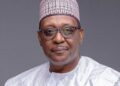
The situation involving the confrontation between Hon. Alex Mascot Ikwechegh and the Minister of Finance, Wale Edun, during a National Assembly committee hearing has triggered national concern. What began as a routine budget defense quickly exposed deeper systemic issues regarding the management and transparency of public funds, at the center of the controversy is a troubling contradiction. The National Assembly approved ₦1.15 trillion to fund approximately 30% of the 2025 capital budget. Simultaneously, Nigeria has accumulated multiple international loans intended for development initiatives, including digital infrastructure, MSME support, economic stimulus, and energy transition. Despite these resources and significant revenue generation by government agencies, many ministries report little to no disbursement for capital projects.
Conversely, capital expenditure is the backbone of development, it finances infrastructure, healthcare systems, education, energy expansion, transportation networks, and economic growth. When capital funds remain undistributed, the consequences extend beyond administrative inefficiency, they directly stall national development and worsen socioeconomic conditions for citizens.
However, during the committee hearing, Minister Wale Edun reportedly redirected responsibility for disbursement to the Minister of State for Finance, Doris Uzoka-Anite, who argued that funds could not be released because some ministries had not met certain pre-disbursement requirements.
Apparently, this explanation raises further questions rather than resolving them.
Nevertheless, if ministries failed to meet documentation requirements, why was such a large amount approved without ensuring readiness for implementation?
Nigerian are asking if funds were appropriated but not disbursed, where exactly are they being held and under what authority?
Again, if disbursement protocols selectively favored some ministries over others, what criteria governed those decisions?
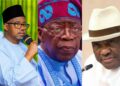
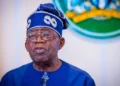
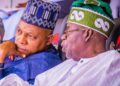
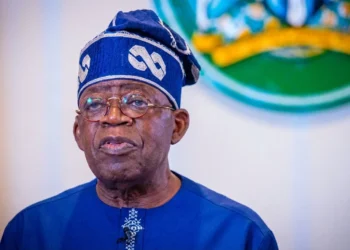
A democratic system cannot function on ambiguity, fiscal transparency is not merely a governance preference, it is the foundation of public legitimacy, even more concerning is the political dimension that followed. Shortly after raising these critical questions, Hon. Alex Mascot Ikwechegh allegedly and reportedly held a closed-door meeting with President Bola Ahmed Tinubu at Aso Rock Presidential Villa. Subsequently, the lawmaker announced his resignation from the All Progressives Grand Alliance and declared his intention to join the All Progressives Congress.
While political realignments are common in Nigeria’s fluid party system, the timing inevitably invites public suspicion. When a critic of government financial management suddenly aligns with the ruling party after a presidential meeting, it creates the perception, whether accurate or not, that accountability has been negotiated rather than pursued.
Meanwhile, for a democracy that is still consolidating its institutions, such perceptions are extremely dangerous.
Nigeria already struggles with deep public distrust toward political institutions, citizens frequently question whether legislative oversight is genuine or merely performative. Essentially, if lawmakers who raise critical financial questions appear to abandon those inquiries shortly after engaging the executive branch, it reinforces the belief that political power can neutralize accountability.
Ultimately, democracy without credible oversight mechanisms gradually evolves into executive dominance, in such a system, legislative institutions risk becoming extensions of political patronage rather than guardians of public accountability.
The African Institute for Statecraft International believes that Nigeria must urgently strengthen its governance architecture to prevent such institutional erosion.
Firstly, the federal government must provide a comprehensive public accounting of the ₦1.15 trillion approved for capital projects. Transparency demands a detailed disclosure of the funds’ current status: whether they remain in treasury accounts, have been reallocated, or are awaiting technical compliance from ministries.
Secondly, the National Assembly must institutionalize an independent budget implementation monitoring framework, budget approval should not mark the end of legislative oversight; it should mark the beginning of continuous monitoring of disbursement and project execution.
Thirdly, Nigeria needs a real-time public financial transparency platform, citizens should be able to track the movement of capital project funds, ministry by ministry and project by project. Digital governance tools already used in many countries can make this possible.
Fourthly, political ethics must be strengthened through legislative reform. Lawmakers who initiate investigations into financial irregularities should not be allowed to quietly abandon such inquiries without presenting final findings to the public. Oversight processes must be institutional, not personality-driven.
Finally, democratic statecraft requires a culture of responsibility across all branches of government. The executive must embrace transparency as a governance strength rather than a political vulnerability. The legislature must protect its oversight authority from partisan compromise. Civil society and policy institutions must continue demanding clarity where ambiguity exists.
Nigeria stands at a critical juncture. The nation cannot continue borrowing heavily while capital development stagnates. Every loan secured in the name of development carries a moral obligation to ensure that the funds translate into roads, hospitals, schools, energy systems, and economic opportunities.
To this end, when development funds disappear into bureaucratic opacity, the burden falls on ordinary citizens who must repay those debts without benefiting from the projects they were meant to finance.
The African Institute for Statecraft International therefore calls for a full and transparent accounting of the ₦1.15 trillion capital allocation controversy. Accountability is not a political attack; it is the lifeblood of democratic governance.
Without transparency, trust erodes.
Without trust, democracy weakens.
And without strong democratic institutions, development becomes impossible.
Nigeria deserves answers, and the future of its democracy depends on them.
Adai Edwin Adai
Policy Scientist, Political Economist, Pan-Africanist.