























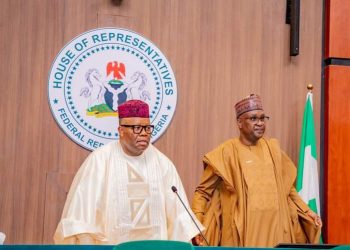

Both chambers of the National Assembly Tuesday provided the Independent National Electoral Commission (INEC), a 60-day window for rescheduling of the 2027 general elections outside the Ramadan (fasting period for the Muslim faithful).

The 60-day window, offered INEC to conduct general elections outside Ramadan in 2027, was reflected in the reduction of 360 days earlier given to the Commission for publication of notice of election, to 300 days.
The new clause 28 states: “The Commission shall, not later than 300 days before the day appointed for holding of an election under this Bill, publish a notice in each State of the Federation and the Federal Capital Territory —
(a) stating the date of the election; and
(b) appointing the place at which nomination papers are to be delivered.”
INEC had, in line with provision of the extant law (Electoral Act 2022) on Friday last week, announced that Presidential and National Assembly election shall hold on February 20, 2026 while the governorship and States Houses of Assembly election shall hold on March 6, 2026.
The reduction of 360 days to 300 days for such notifications by INEC, offers it the time latitude of fixing such elections for January 2027.
Specifically, in his motion for the amendment, Senate Leader Opeyemi Bamidele (Ekiti Central) said upon critical review of the bill as earlier passed, it was observed that the 360-day notice requirement prescribed in clause 28 may result in the scheduling of the 2027 Presidential and National Assembly elections within the period of Ramadan.
“The coincidence of the elections with the Ramadan period, could adversely affect voters turnout, logistical coordination, stakeholder engagement and the overall inclusiveness and credibility of the electoral process,” Bamidele said.
Consequently, he moved that upon painstaking scrutiny of the bill, discrepancies were identified in the Long Title and Clauses 6, 9, 10, 22, 23, 28, 29, 32, 42, 47, 51, 60, 62, 64, 65, 73, 77, 86,87,89, 93, and 143 which affected other clauses of the bill , including issues relating to cross-referencing , serial numbering and internal consistency, the Senate should rescind its decision on the Electoral Act 2022 (Repeal and Enactment) Bill, 2026 as previously passed and re – commit the bill to the committee of the whole for comprehensive reconsideration and necessary amendment.
The Senate accordingly went into committee of the whole for the comprehensive amendment.
The process, however, ran into troubled waters when it got to clause 60 with vehement opposition from Senator Enyinnaya Abaribe (Abia South) who called for division on those for and against real-time electronic transmission of election results.
But when the division was made by the President of the Senate, Godswill Akpabio , those in support of clause 60( 3) as passed last week had their way with 55 votes against those against who had just 15 votes.
The clause states: “Presiding Officer shall electronically transmit election results from each polling unit to IREV portal and such transmission shall be done after the prescribed Form EC8A has been signed and stamped by the Presiding officer and/or countersigned by the candidates or Polling agents where available at the Polling Unit.
Provided that if the electronic transmission of the result fails as a result of communication failure and it becomes impossible to transmit the result contained in form EC8A signed and stamped by the Presiding Officer and countersigned by the candidates or polling agents where available at the polling unit, the Form EC8A shall remain the primary source of collation and declaration of the result.
Also, Clause 84 on Nomination of candidates by parties provided that: “(1) A political party seeking to nominate candidates for elections under this Bill shall hold primaries for aspirants to all elective positions which shall be monitored by the Commission.
“(2) The procedure for the nomination of candidates by political parties for the various elective positions shall be by direct primaries or consensus.”
…Our angst – Opposition members
Briefing journalists after the walkout, the opposition members, led by the Minority Leader, Hon. Kingsley Chinda, said they have a “responsibility to let Nigerians know what happened, particularly, section 60 which we said results should be electronically transmitted without any room for manipulation, but they turned it down, not because of the interest of Nigerians but APC’s.”
They also argued that primary elections are exclusive internal practice of the political parties, and therefore remained out of place to restrict them to the options of only “direct” and “consensus” options, leaving out “indirect” alternative.
“Primaries should be internal affairs of the party to adopt and choose whichever that suits them,” Chinda said.
…It’s historic – House
However, the House has described the success of the process as “historic for Nigeria, as the entire process was very much in line with the Standing Orders of the House.”
Spokesman of the House, Hon. Akin Rotimi told journalists that beyond the controversies surrounding some of the clauses, it was in the opinion of the majority that the best thing has been done for the country, citing the adjustment to Clause 28(1), leaving INEC with an allowance to adjust the election timetable, if need be.
The new Clause 28(1) provided that “The Commission shall, not later than 300 days before the day appointed for holding of an election under this Bill, publish a notice in each State of the Federation and the Federal Capital Territory;
(a) stating the date of the election; and
(b) appointing the place at which nomination papers are to be delivered.
Earlier, the House, had, during the session rescinded its passage of the bill, and recommitted same to its Committee of the Whole for fresh consideration in order to address all discrepancies, as well as address fresh issues occasioned by issuance of election timetable by INEC.