















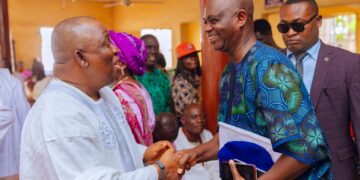









Nigerian politicians now rely on election tribunals to determine electoral victories rather than voters, the immediate past President of the Nigerian Bar Association (NBA), Mazi Afam Osigwe, SAN, has said.
Osigwe spoke on Thursday while delivering an address titled “Election Petition in the Digital Age: Independence, Evidence, BVAS” at the 22nd Nigeria Guild of Editors Conference in Enugu.
He criticised the increasing judicialisation of Nigeria’s electoral process, saying courts had gradually assumed the role of voters in determining elected representatives because of difficulties in proving breaches of electoral laws.
“A judge, a very good friend of mine, once presented a paper and called it ‘The Judicialization of the Electoral Process.’ He argued that because of the difficulty of proving non-compliance with the Electoral Act, the courts have gradually and increasingly usurped the role of the voters in determining the representatives of the people. And I couldn’t have agreed with him more,” he said.
Osigwe said Nigeria has one of the highest numbers of election petitions globally, arguing that politicians increasingly depend on tribunals rather than voters to determine electoral victories.
He also criticised the slow pace of Nigeria’s judicial process, contrasting it with the United States Supreme Court’s handling of a case involving former President Donald Trump and US Postal Service voting protocols.
“I don’t know how long such a process would have taken if it were Nigeria, or if our courts would have had the boldness to decide decisively,” he said.
Osigwe attributed the broader electoral crisis to leadership failure, citing Chinua Achebe’s The Trouble with Nigeria.
“Chinua Achebe, in his book The Trouble with Nigeria, identifies leadership as the problem. He says, ‘The trouble with Nigeria is simply and squarely a failure of leadership.’ And this failure of leadership is found in our homes, in our organizations, and everywhere we work, not just in the presidency or governorships.”
He also acknowledged problems within the legal profession, saying lawyers sometimes deploy complicated arguments that make it difficult for judges to follow their cases.
Turning to the Independent National Electoral Commission (INEC), Osigwe said declining voter turnout reflected growing public distrust in the electoral process.
“If you check the voter turnout data, increasingly, fewer Nigerians are coming out to participate in elections. It’s because many Nigerians do not believe that whatever votes they cast matter or count,” he said.
He criticised the opaqueness surrounding collation of results, particularly when the process extends into the night.
“They believe that between the polling units where they vote and the announcement of results at collation centres, especially if collation drags into the night, miracles are suspected to have happened before daybreak. So, why vote?” he asked.
According to Osigwe, politicians exploit this distrust by inducing voters with food and money while recruiting young people to perpetrate electoral violence.
“Politicians, knowing that the people don’t have confidence in them, prey on the people by giving them money, salt, and rice, while recruiting helpless young men as thugs to unleash violence,” he said.
He also criticised the political influence surrounding state electoral commissions, saying ruling parties often record perceptibly undeserved sweeping victories i