















By Paul Mumeh
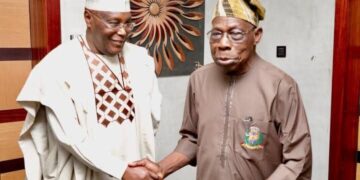
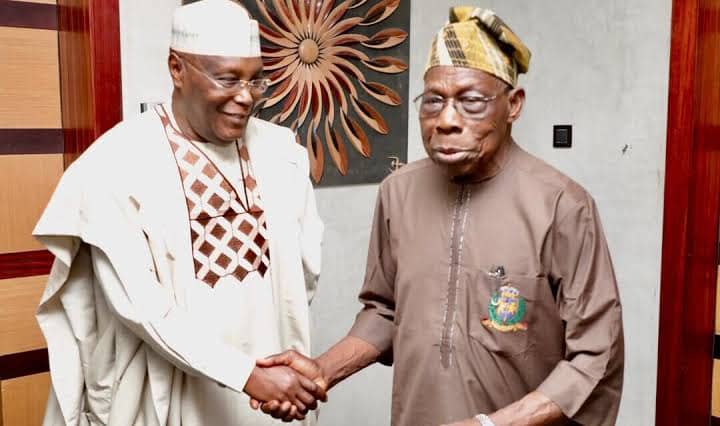
The renewed public clash between former President Olusegun Obasanjo and former Vice President Atiku Abubakar is more than a personal disagreement. It has become one of the longest-running political rivalries in Nigeria’s Fourth Republic, and its latest chapter carries significant implications for the 2027 general election.
A Rivalry That Refuses to End
The Obasanjo-Atiku relationship has travelled a remarkable political journey—from trusted allies who jointly defeated the alliance of the All Peoples Party (APP) and the Alliance for Democracy (AD) in the 1999 and 2003 elections—to bitter rivals whose disagreements have endured for nearly two decades.
Their fallout began during Obasanjo’s second term, culminating in the controversial third-term amendment debate of 2006. Atiku insists he opposed what he described as an unconstitutional attempt to extend Obasanjo’s tenure, while Obasanjo maintains that his deputy was driven by presidential ambition and disloyalty. Since then, each has consistently sought to define the historical narrative of that turbulent period.
The truth, however, is that neither man is entirely blameless. Both were major players in the politics of the era. Obasanjo was widely alleged to have sponsored the pro-third-term campaign, while Atiku was equally accused of financing the anti-third-term movement. From both sides of the divide, many lawmakers in the Senate and the House of Representatives reportedly benefited politically and financially from the ill-fated constitutional amendment process.
The latest allegation—that Atiku attempted to bribe the late Speaker, Ghali Umar Na’Abba, to facilitate impeachment proceedings against Obasanjo—is therefore not an isolated claim. Rather, it fits into a long pattern of mutual recriminations that has defined their relationship.
Why Now?
The timing of this renewed confrontation is perhaps its most significant aspect.
With political alignments ahead of the 2027 elections becoming clearer, every intervention by influential political figures is inevitably interpreted through an electoral lens.
Atiku believes Obasanjo’s renewed attacks are intended to weaken his credibility at a time when opposition forces are consolidating. His response—that Nigerians are more concerned about inflation, insecurity, unemployment and governance failures than historical political disputes—is an attempt to shift public attention from personality politics to policy issues.
Obasanjo, on the other hand, appears determined to shape public perceptions of political leadership by revisiting his experience with Atiku. Whether motivated by personal conviction or contemporary political calculations, his comments inevitably influence conversations within opposition circles.
Battle for Political Legacy
This feud is equally a contest over history.
Obasanjo wants history to remember him as the leader betrayed by an ambitious deputy.
Atiku wants history to remember himself as the statesman who resisted an alleged attempt to alter Nigeria’s constitutional order through a third-term agenda.
Neither man appears willing to concede that narrative.
Implications for the Opposition
The renewed exchange comes at an awkward moment for opposition politics.
Should Atiku remain a leading opposition figure in 2027, persistent attacks from someone of Obasanjo’s stature may provide ammunition for his political opponents.
Conversely, many younger Nigerians may see the feud as yet another chapter in an old political rivalry with diminishing relevance to contemporary governance challenges.
The bigger concern for opposition parties is whether prolonged personality conflicts distract from presenting coherent alternatives on the economy, security, electricity, education and institutional reforms.
Public Mood Has Changed
Nigeria today is markedly different from the Nigeria of 2003 or 2007.
Many younger voters have little emotional attachment to the Obasanjo-Atiku era. Their concerns are far more immediate:
Rising cost of living.
Persistent insecurity.
High unemployment.
Weak purchasing power.
Governance and accountability.
To many voters, arguments over who betrayed whom two decades ago matter far less than credible solutions to today’s challenges.
The Politics of Endorsement
Obasanjo has increasingly assumed the role of an elder statesman whose political interventions often shape elite conversations, though not always electoral outcomes.
Over the years, he has publicly criticised several presidents, governors and former allies, reinforcing his reputation as an outspoken commentator on national affairs.
Whether his latest intervention significantly alters Atiku’s political prospects depends less on the allegations themselves than on whether opposition coalitions remain united and whether Nigerians judge candidates based on present realities rather than historical disputes.
Conclusion
The Obasanjo-Atiku feud has become one of Nigeria’s most enduring political sagas. It reflects unresolved questions about loyalty, succession, constitutionalism and political ambition that have lingered since the mid-2000s.
As the 2027 elections approach, however, the political significance of their personal rivalry may ultimately be eclipsed by a more pressing national question: which political actors can convincingly address Nigeria’s economic hardship, insecurity and governance challenges?
For many Nigerians, the election is likely to be decided less by competing accounts of past political betrayals than by competing visions for the country’s future.
History may continue to judge the Obasanjo-Atiku relationship, but the electorate will almost certainly judge those seeking power by their capacity to solve today’s problems—not yesterday’s quarrels.
* Mumeh