














By Monday Uwagwu
No greater fool exists than one who is ignorant of his/her history– Ancient African Proverb.
This wise crack tells the story, in my view, of my people – Nigerians – who have chosen, quite unwisely, especially with regard to the polity, particularly June 12, 1993 presidential and other elections of that great year, to remain transfixed.
I had long thought that I would never again return to the sad story of June 12, 1993 presidential poll. And my reason had been simple, short and straight forward….it remains a sad reminder of how a people, ignorantly lost their hour in the sun of glory and global acclaim.
Secondly, the poll and its lead up processes had a personal meaning for me…I was deeply involved in the presidential campaign of the presumed winner , Basorun M. K.O. Abiola, as the Government House, Benin correspondent of The great Nigerian Observer newspapers, and had the rare privilege of accompanying then Governor of Edo State, Chief John Evbuonmwan Oyegun, who was of the defunct Social Democratic Party(SDP) as Basorun Abiola.
However, two things have made me to rethink my earlier resolution to steer clear of June 12: the fact of its subsisting relevance to our current political situation, and the uniqueness of this year’ s anniversary..the 33rd.
Anyone quite familiar with the importance of the number 33 will readily agree that it is not just a run- of- the- mill number. The number 33, in basic Cosmology and Psychic Science, is critically significant. Even in basic science, it also has importance as the boiling point of water when the science works gave the free works its first thermometer.
So, against the grain of my initial resolution, I return, today, to how my people messed up their great hour of relevance and uncommon political attainment.
How sad indeed!
Yes, some 33 (yes, thirty-three) Gregorian calendar years ago, Nigerians, like one man, rose to take his fate in his hands by electing, on the basis of their knowledge of what was at play and the prospect of the National Project going forward, the man they felt was best suited to lead them as elected President. At least, that was what the outcome of the presidential poll pointed to before leaders of Nigeria’s military junta, then led by Gen. Ibrahim Babangida, disposing like medieval-era European Emperors, annulled it.
After the controversial annulment (there still exists no credible official explanation for the cancellation of the poll by those behind it), the Babangida administration set up an incredulous contraption called the Interim National Government (ING) led by former General Manager of the United African Company of Nigeria, (UACN), Chief Ernest Shonekan, as its head, and the inscrutable General Sani Abacha, as its deputy head. The ING – mysterious in conception, legality, relevance and credibility – was meant to assuage the angry Nigerian public which had felt let down by the controversial action of the ‘step aside’ self-styled evil genius, General Babangida, by naming a civilian (Shonekan, the second Nigerian to head the UAC after Christopher Abebe) as its head. Besides, the choice of a Yoruba was particularly targeted at that section of the Nigerian demography which felt that one of its own (Abiola, who was then their chief warrior and war commander of the Yoruba by the title of Aare Ona Kakanfo), had been unjustly denied his due of the presidency.
The philosophy of atonement inherent in the choice of Shonekan as ING head and Head of State, was later to be replicated by the subsequent administration of General Abdulsalami Abubakar (after the mysterious deaths – a month apart of each other – of both Abacha and Abiola, the latter in state custody), chaperoned the two major parties (the Peoples Democratic Party, PDP) and the then All Peoples Party, APP) to field Yoruba – only presidential candidates in the 1999 presidential poll. The PDP, led by former military Head of State, Chief Olusegun Matthew Aremu Okikiola Obasanjo – won the election by defeating the APP candidate and renowned Economist, Chief Olu Falae, in that poll and was later installed President and leader of the country in its Fourth Republic.
Since the return of civil rule to our shores in 1999, the polity has been somewhat stable, with the successful transition of power from one elected President to another.
Even at the level of states, the transition has been relatively smooth.
However, if the truth be told, despite an impressive somewhat successful transition of power at all levels and or tiers of public administration, there obviously remains an enduring need for the close examination of our current democratic experience with a view to understanding why we appear stuck on the same groove and whether, in the face of our inchoate current realities, it could not be compulsive wisdom for us to return, post haste, to Option A4 and the queueing culture as part of efforts to curb waste, avoidable waste, that our current political module has foisted us.
I had never met Basorun M.K.O. Abiola until the March 21-23 1993 Presidential primary election in Jos, Plateau State.
In that primary poll, notable Nigerians, including Sarah Jubril, Chief Ralph Obioha, Ambassador Babagana Kingibe, Chief Abiola and Abubakar Atiku vied for honour, that is the presidential ticket of the now defunct SDP.
That event held at the Jos Township Stadium, Jos, and at that great event, I had the privilege of working with great media icons, including Dupe Ajayi of Daily Times and our own inimitable entertainment news guru, Francis Onochie of Delta Broadcasting Service( bless his great soul).
It is needless to recall that the battle was titanic, and the atmosphere, charged but convivial. It was initially thought that the game would be too close to call, as it is now said in keen contests, given the calibre of the aspirants.
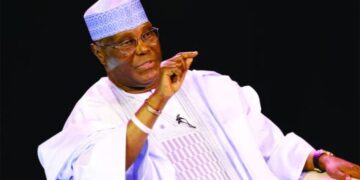
But in the long run, Abubakar Atiku, who was showing a lot of potency against Abiola, had to be persuaded by former military man and erstwhile Secretary, Supreme Headquarters, Shehu Yar’Adua, to publicly step down for Basorun. Following Atiku’s stepdown, Abiola won the primary poll and was declared SDP presidential flag bearer.
The reaction of the throng at the stadium was tumultuous and the excitement was evidently palpable.
But something happened that was eventually to prove prophetic in a way. As Abiola mounted the young white horse (the SDP had a rare white horse, the Unicorn, as its symbol), a storm erupted at the venue: By the time it eased, every canopy in the stadium had collapsed and fallen.
Before then, however, a ‘small’ symbolic thing had actually happened. To make their cases before the thousands of delegates at the stadium, each aspirant had five (5) minutes to wrap up his campaign, by addressing the delegates. Everyone was wondering how it would turn out for Abiola, an established stammerer of unequalled disposition. Everyone also knew that when it comes to oratory and the gift of efficient language use, Kingibe had no match.
However, as events turned out, while Abiola, an incurable stammerer, spoke seamlessly for the period, Kingibe was the one who appeared to struggle with his delivery.
Everyone was shocked. It was part of the great fun that the SDP convention had turned into, with delegates from across all of the four major wind directions of Nigeria strenuously marketing the Nigerian Project and the undying brotherhood underlying it.
That was in March 1993.
When the party (SDP) held its convention for the election of its national officers, something happened. Everyone thought the South-Eastern flank of Nigeria was to produce the National Chairman of the party and every analytical finger had pointed in the direction of Architect Ekong Etuk as the man the cap fits. As voting progressed, everyone thought it was a done deal. Basking in unjustified confidence, the Ekong Etuk camp, falsely believing that the prize was already in their kitty, left early when delegates from a few states – mainly from the geographic north – had yet to vote. That proved to be their undoing. Ever so dynamic, the Tony Anenih camp, seeing this tactical mistake on the part of the Ekong Etuk camp, capitalized on it, and although there are no harmonized view on the strategy it adopted, it (Anenih camp) rode over the other, and when the result was announced, a bewildered Eastern bloc rejected the result and cried foul. That was around 3 am.
Following this dispute over the result, Abiola – who had got intelligence of the development from his son, Kola – now had to call an emergency meeting of the party’s Eastern bloc and elders of the party at which he reportedly consented to refund whatever the Ekong Etuk camp had expended on its campaign and made some other personal promises to him. Reluctantly, the bloc, in deference to the appeal of the elders and Abiola, conceded and it was resolved that everyone should let Anenih be. Even then, Anenih could not immediately do his post-inaugural/acceptance speech.
The Ekong group had alleged vote buying in rejecting the result, and, in addition, had, just like a few other insiders, spoken of their doubt about Anenih’s ability to stand by the party, in the event of any crisis in the future. This fear, though thought unfounded initially, eventually proved prophetic because, quite unlike what was expected, Anenih was reluctant to receive MKO Abiola in his GRA, Benin City, residence much later when he (Abiola) returned to Nigeria from exile in France.
In opting to retain the status quo (with the Anenih chairmanship), Abiola had said that since he was finding it difficult to pick a running mate (Atiku Abubakar, Kingibe, Paschal Bafyau – then NLC President – were all linked to that aspiration), it would be utterly unwise to literally add salt to a festering injury by allowing the Eastern bloc go to court to challenge the poll or defect to another party as it had threatened.
Today, decades down the line, it is still debatable whether the decision to allow Anenih be was a wise one, given what transpired later.
I leave that matter for another day.
For now, as I said, MKO in my few personal contacts with him, left a deep positive impression in my mind.
And this is how.
Abiola, Aareonakakanfo, was a people’s general and was well schooled, inspite of his tremendous personal wealth, in human relations, corporate engagement and humility. He was, inspite of being a stammerer, a credible communicator extraordinaire gifted in wits and wise cracks. He could speak for hours, lacing each statement with relevant proverbs. I remember him telling us, after a hectic campaign, that whatever quarrel the barber has with the vulture has nothing to do with its hair.
Of course, I could fill a whole book with the proverbs he made with effortless ease in the course of the campaign across the country. Particularly, I remember him telling us that even evil the genius cannot clap with only one hand.
His humility was extraordinary as was his ability to resolve issues. At the launch of his campaign in Kaduna (Polo ground), initially, there was no water or food to drink and eat, and it was rumoured that the funds he had made available for that purpose had developed wings and flown into some persons’ pockets.
But Abiola, just before anyone began to grumble, had gone round the problem: an alternative was found and everyone had a round stomach, thereafter.
At the same occasion, everyone was expecting him to come forward with a long and perhaps, boring, speech, but not him. After Sule Lamido, the SDP National Secretary, had spoken, Abiola only appeared on stage spoke succibtjy but tersely, and, in a gesture vowing faith and loyalty to the National Project and the national flag, bowed: Everyone clapped. He had demonstrated what a million words won’t convey with accuracy. Happily, everyone went home.
During his campaign trips to the East, especially Enugu and Nsukka, Abiola, by his magic wand, was able to not only attract the flower of the political class and get their buy in, but even the idolized Zik of Africa, who spoke in Ibo, demonstrated faith in the new beginning when he said Nigerians, especially Ibos, should put behind them the unnecessary acrimony that existed between him and the great mystical philosopher and former Premier of Western Region, Obafemi Awolowo.
I recall that on that occasion, Zik spoke in Ibo and I was the one who interpreted his short speech for other journalists there, including Dupe Ajayi of Daily Times, who did not understand the Ibo language.
Yet, there was a little more to the outing. As in Nsukka, so in Abakiliki: the great Ibo warriors put up a rare dance in acceptance of their son, Abiola.
In Ologbo, Edo State, something also happened. Abiola’s advance campaign team had arrived and was received by the local elders. But while the team was about to open up on why they were in town, the elders, after confirming that the visit was on account of Abiola, stopped them, shared communion with the drinks and kolanuts and bade them (campaign team) to return home in God’s peace. They (elders) said they won’t waste their (campaign team’s) energy recalling a pleasant story they were already at home with: according to them, long before the campaign team’s arrival, they had already vowed – one and all – to vote Abiola, who had awarded several of their indigenes academic scholarships.
At Irrua, the ancestral and spiritual home of the great Esan people of Edo State, the Abiola campaign train was 12 hours behind schedule. Ordinarily, this delayed arrival could have created some challenges for Abiola, having kept the throng waiting for unduly long. Yet, when it arrived by 11pm, the throng, led by the Ogirrua (traditional ruler), were still waiting – keeping faith with the man the Ogirrua called his son.
Abiola, stunned by that incredible fidelity, had to lie flat in the muddy water in the palace and vowed never to get up, unless so instructed by the royal father. Everyone was shocked, including even the Ogirrua, who touched his (Abiola’s) back with his staff of office, in a symbolic gesture ordering him to stand up. And, like almost everywhere else, the crowd was satisfied with seeing Abiola, who moved round, shaking hands with as many as he could.
There was hardly much oral communication: the body language of the Ogirrua and his subjects spoke volumes of their acceptance of Abiola, whom many were seeing korokoro, as my people say, for the first time in their lives.
There was another occasion when Abiola displayed one of his many virtues-gratitude or appreciation.
Upon his return to Nigeria from France, Abiola visited stakeholders in Benin and was treated to a luncheon at Government House. After the meal, MKO called top government officials to inquire who prepared the meal; after he was told, he sent for her. In unsteady foot steps, the ageing caterer in Government House, apparently a low cadre staff.member, turned up, obviously nervous. The situation, at least, for her, became tense, and everyone who was discerning saw that she was fidgeting not just physically but also in spirit.
However, to her eternal relief, Abiola only asked her personal questions relating to her family to which she responded that she was the bread winner of the family of herself, her aged husband and several children who were already out of secondary school but had no material means to pursue further education.
In deep patience, Abiola heard her out and, as was typical of him, beckoned on Kola, his son, in a gesture that only both of them could truly decipher. Moments later, Kola returned with two giant brown envelopes that evidently had been stuffed with hard cash. Abiola, in a most humble manner, handed over the two giant envelopes to the still shivering caterer who had not only been transfixed but also dumbfounded.
In place of words, her tears spoke volumes as Abiola advised her to hand over the money to her immediate family for the building of their personal house and for the education of their children in higher school, since, by his calculation, the contents of both (envelopes) could suffice for the intended purposes.
As on several other occasions, Abiola left everyone happy.
One more thing, though.
Abiola was a stickler for competency and was a great symbol of humility. All through the campaign – at least those I was privileged to attend, and these were indeed many – Abiola would gather journalists at the end of the day for a critical review of the activities of the day. At such gatherings, two things almost always happened: he would prepare and serve everyone tea – his favourite meal (it was not surprising that he was reportedly eventually undone with a laced cup of tea as alleged), and he would entertain critical questions, no matter how probing, without showing the slightest sign of weariness or unease. His answers were potent, relevant, correct and honest…everyinr could feel that.
That was Abiola, our own dear Abiola.
As for his die-hard attitude to quality and competency, it was self-evident in everything he did. For instance, he preferred Chris Mamman, a Deltan, as head of his media and communication team in place of the legion other competent media managers of Yoruba extraction. He extended the same virtue by hiring Sonny Okosun, a minority from the Esan village of Ibore in Edo State, as his choice musician for his campaigns.
It was the Ozziddi King who lit up and set alight every throng at the legion campaign venues that Abiola mounted in the course of his pursuit of his presidential ambition, and the great musician delivered to precision.
What more can I say?
Abiola, by every honest calculation, may not have been a perfect being. None is, anyway.
However, the values he shared and the prospect he represented for Nigeria, Africa’s giant, were never in doubt.
Today, long after we lost him to butchery at the hands of those who should know better, our nation, now in the throes of multiple, avoidable crises, needs his type for the unity he symbolized and which we are now fast losing.
For me, the loss is understandably deeper not only because I was, as a journalist covering the event, in the heat of all of what made June 12 feasible, but also because of a vow that his death has prevented Abiola from fulfilling to me. He used to call me ‘my intelligent inlaw’ because he allegedly sired a child by a woman from the great Agbor Kingdom from which I hail.
That ( promise) was, and remains, personal, and his mysterious premature death has made its fulfilment now impossible .
But I have taken solace, at a very personal level, and immortalized him by naming Ngozi, the first daughter from my loin, after him. That is the least I can do for a man who gave Nigerians – from every divide – a sense of belonging and the hope, the great hope, it offered.
To God be the glory.
* UWAGWU; Former General Manager and Editor -In-Chief of Pointer nrwspapers ltd writes from Asaba , Delta state.