




















by Olu Onemola

On the 2nd of July, 2025, Senator David Mark, the former General and Senate President, a man known for few words and more action, stood on stage at the main hall of the Yar’Adua Center and confirmed the whispers that had been circulating: the opposition coalition had found a new home. The African Democratic Congress (ADC).
Standing alongside other political generals, men and women who had seen wars and battles from different sides, veterans who were household names, he declared that the road ahead for the opposition would “be a long, difficult and tedious journey”, and that he and the people on that stage were prepared to undertake that journey regardless of the consequences.
Exactly nine months to the day that Senator Mark made that statement, the members of the Opposition Coalition gathered once again at the Yar’Adua Center to make an entirely different kind of proclamation.
You see, nine months is a long time, in both life and in politics. In life, nine months is the time it takes for a zygote to become a newborn. Like a zygote, on July 2nd, 2025, the opposition coalition was launched into Nigeria’s consciousness. But it was not until April 2nd, 2026, that the real opposition coalition was fully born.
This is because when it first started, the ADC was a collection of individuals, people who agreed that the country was on an unstable and unsustainable path. However, each had his own view of the future. Some believed that being political gentlemen in a time of political gangsters would set the party apart as a credible alternative. Others believed that power only respects power, and that credibility without strength is often ignored.
Yet, in the time since its announcement, the party has seen its offices burnt, with no perpetrators apprehended; its members beaten, maimed, shot at, killed, incarcerated, and politically taken out of circulation. Still, it maintained calm. Still, it asked its members to stay level-headed. “Be law-abiding.” It spoke the language of statesmen in a time when the system was speaking the language of force.
But something changed on April 1st, 2026.
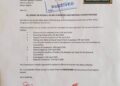
Like an April Fool’s joke in the middle of the night, the political chessboard was redrawn by INEC, the Independent National Electoral Commission. To attempt to explain the “why” is to give credence to fiction in an article of facts. However, in a press statement, the electoral umpire, in what will be remembered as the April 1st Coup, proclaimed that it would not recognise the leadership of the ADC.
Now, this is where things get interesting.
Because, as we have established, over the last nine months, the ADC had done almost everything it needed to do to prepare. It had built structures across the country. It had started its mobilisation, reaching 2.6 million people in just over seven weeks, compared to a ruling party that, through a mix of coercion and incentives, reached 11 million people in twelve months.
The party had also established a policy committee, a team it called the 50 Wise Men and Women, to develop an agenda for an ADC government. Internally, it developed a Code of Ethics, binding principles aimed at creating a party that would stand the test of time, not just another special purpose vehicle. Still, the opposition was not yet born.
Most importantly, the party had started recruiting. The political generals had been joined by others, and more generals and their lieutenants were said to be on their way. The fear of a real opposition was beginning to take shape, with the three main candidates, who had cumulatively secured more than double the sitting president’s votes, now in the ADC’s fold. Still, the opposition was not yet born.
It is said that this is why, on April 1st, acting on instructions from “above”, INEC decided to de-recognise David Mark’s leadership of the ADC. With the ADC congresses just a day away, resources already deployed, and new entrants signalling their arrival, INEC decided to act.
Those of us who grew up during the time of General Sani Abacha remember the evening news. I remember the night it was announced that General Oladipo Diya had been apprehended for attempting to unseat Nigeria’s last military ruler. It was delivered with a calm, official finality, the kind that left no room for response. INEC’s announcement carried a similar quality.
But that night, you could feel something shift.
People reacted in the way that people do when something shifts beneath the surface. Social media amplified the moment, but beneath the noise was something quieter and more consequential. People who had been indifferent were no longer indifferent. People who had been watching from a distance began to lean in. Still, the opposition was not yet born.
That happened the next day.
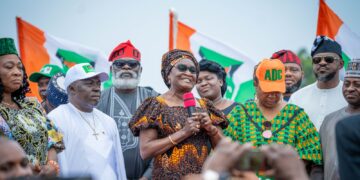
Life, like the universe, has a sense of humour. As opposition leaders gathered again at the Yar’Adua Center, the spaces intended for the press conference could no longer contain them. Nine months earlier, every hall in the center could hold them. Now, their support base had grown so large that the press conference had to be moved outside to accommodate the crowd that assembled organically.
It was during this moment that the opposition’s water finally broke.
For nine months, the party had done everything required to be a party, in principle. But it was with one simple question, a quiet, defiant line in a speech largely addressed to INEC, that Nigeria’s political opposition was finally born.
As he read through his speech, the Chairman of the ADC paused and said:
“Right now, I speak to Nigerians at home and in the diaspora. I also speak directly to President Bola Ahmed Tinubu: with 90% of the National Assembly and over 30 of Nigeria’s 36 Governors in the APC, President Tinubu, what are you afraid of? If you are convinced that you have done well for the people who voted for you, why are you afraid of a free, fair, and transparent electoral contest? If you are indeed the democrat that you claim to be, why are you bent on destroying all opposition political parties?”
What made that moment different was not just the question. It was what sat behind it. For nine months, the ADC had behaved like a party waiting to be recognised. Careful. Measured. Respectful of process. It believed, perhaps naively, that if it did everything right, the system would respond in kind. But history does not reward good behaviour.
“What are you afraid of?” It hung in the air as an invitation for Nigerians to answer for themselves.
Because by April 2nd, the equation had changed. This was no longer a conversation about party structures, court rulings, or INEC memos. It had become something else entirely. A contest between fear and resolve. Between a system trying to preserve the status quo, and a people beginning to outgrow it.
This is how political movements are born. Not in conference halls. Not in carefully-worded communiqués. But in moments of friction, when the system pushes, and the people decide, quietly at first, that they are ready to push back.
INEC’s April 1st decision was meant to stall the opposition. Instead, it completed it. Because what INEC attempted to take away, it unintentionally gave: clarity. Clarity that this would not be a normal political cycle. Clarity that the rules would not be neutral. Clarity that the path ahead would not be negotiated, but contested.
And clarity, above all, that the opposition could no longer afford to behave like guests in a house that was being locked against them. It had to become something else. Something sharper. Something more certain of itself. Something willing to match power with purpose. That is what was born on April 2nd.
Nine months ago, the ADC was announced. On April 2nd, 2026, it was finally born.
And now, like anything that has finally come into the world, it will have to do the one thing that defines whether it lives or dies:
Grow.
– Olu Onemola writes from Abuja