














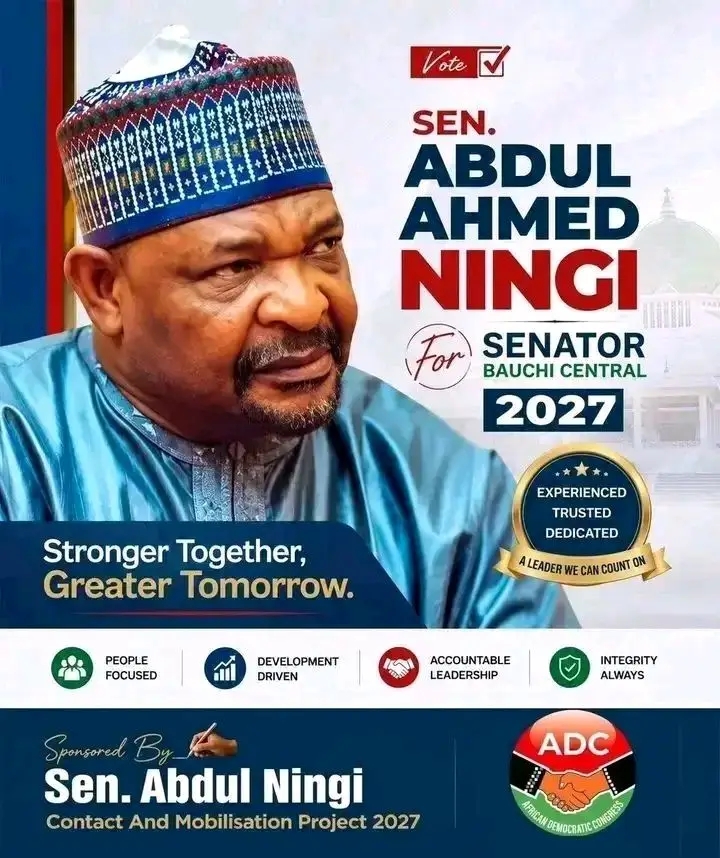


By Umar Usman Duguri
In a political environment where public representation is often measured by rhetoric, visibility and political influence, Senator Abdul Ningi stands out as a public servant whose career offers a compelling perspective on what it means to represent the people.
Representation, in its truest sense, is not merely about occupying an elected position. It is about giving voice to the voiceless, defending the interests of constituents, scrutinising government policies, contributing meaningfully to legislation and remaining connected to the people whose mandate makes public office possible.
It is against this broader understanding of public service that Senator Abdul Ningi deserves commendation.
As a legislator, Ningi has over the years built a reputation for being outspoken on issues of national importance and for engaging actively in conversations around governance, accountability and the welfare of Nigerians. His approach to public affairs has frequently reflected the conviction that elected representatives must not become detached from the realities confronting ordinary citizens.
For The Analyst, that principle remains central to the meaning of exemplary representation.
Representation Beyond Political Office
Public office carries with it a responsibility that extends far beyond the privileges attached to political positions.
A senator is not simply a participant in parliamentary proceedings. He or she is expected to serve as a bridge between citizens and government, bringing the concerns of communities to the national policy table while equally explaining government decisions to the people.
This responsibility becomes particularly significant in a country such as Nigeria, where citizens continue to contend with economic pressures, unemployment, insecurity, inadequate infrastructure and challenges in accessing basic public services.
Effective representation therefore requires courage, accessibility, intellectual engagement and an enduring commitment to public interest.
These are qualities that have featured prominently in discussions about Senator Ningi’s political career.
His willingness to speak on contentious national issues has also demonstrated an important feature of democratic governance: the legislature must retain the capacity to question, scrutinise and, where necessary, challenge policies and decisions that affect the people.
Giving Constituency Interests a National Voice
One of the most important responsibilities of a senator is to ensure that the concerns of his constituency are not lost within the broader national political conversation.
For constituents, representation is meaningful when their needs are articulated at the highest level of government.
This involves advocating for development projects, supporting policies that improve livelihoods, drawing attention to local challenges and ensuring that citizens have a representative who can take their concerns beyond the immediate community.
Senator Ningi’s public engagement has contributed to this broader understanding of constituency representation.
His political interventions have often attracted national attention, reflecting the reality that effective representation sometimes requires a legislator to move beyond comfortable political positions and engage difficult questions.
That willingness to participate in difficult conversations is essential to a functioning democracy.
The Courage to Speak
Democracy thrives on disagreement.
A parliament in which every member simply endorses every government position would hardly serve the interests of the people. Constructive disagreement, informed criticism and rigorous scrutiny are necessary ingredients of democratic accountability.
Senator Ningi’s public career has demonstrated a willingness to speak his mind on matters he considers important to the country.
Such courage is not without political consequences.
Public officials who speak openly on sensitive matters can attract criticism from political opponents, supporters and even members of their own political constituencies. Yet, the responsibility of representation demands that elected officials sometimes prioritise principle and public interest over political convenience.
That is one reason why political courage remains an important measure of leadership.
A Voice for Accountability
Accountability is one of the pillars of representative government.
Citizens have the right to know how public resources are allocated, how government policies are formulated and whether elected institutions are delivering on their responsibilities.
Legislators, by virtue of their constitutional responsibilities, occupy a strategic position in promoting this accountability.
Senator Ningi’s interventions in national affairs have often placed him within conversations concerning transparency, governance and the performance of public institutions.
Whether one agrees with every position he has taken is a different matter. What remains important is the contribution that robust public debate makes to democratic development.
A healthy democracy does not require uniformity of opinion. It requires institutions and individuals willing to ask difficult questions.
The Importance of Constituency Connection
Perhaps the most significant test of political representation is the relationship between an elected official and the people.
Citizens want representatives who understand their everyday struggles—not politicians who appear only during elections.
The people expect their representatives to remain accessible, responsive and attentive to the realities of their communities.
For Senator Ningi, the challenge, as with every public official, is to continue strengthening that connection and ensuring that political representation translates into tangible benefits for constituents.
The standard should always be higher than political popularity.
It should be about measurable impact.
Leadership Beyond Party Lines
Nigeria’s political system is deeply partisan, but the responsibilities of public office should ultimately transcend party interests.
A senator represents citizens with different political affiliations, religious backgrounds, social circumstances and ideological preferences.
The ultimate obligation is therefore to the constitution and the people.
This is where the concept of a “servant of the people” acquires its deepest meaning.
Public office is temporary. Political appointments and electoral mandates eventually come to an end. What survives is the record of service left behind.
For leaders such as Senator Ningi, the enduring question is not simply how long they remained politically relevant, but what contribution their time in public office made to democratic governance and the lives of the people they represented.
The Standard Nigeria Needs
Nigeria requires a new culture of political accountability in which elected representatives are judged less by the size of their political entourage and more by the quality of their service.
The country needs legislators who understand that parliamentary seats are not personal possessions but positions of public trust.
It needs leaders who can listen to their constituents, understand national challenges, contribute intelligently to legislation and defend the public interest.
It also needs citizens who are prepared to demand evidence of performance from those they elect.
In this regard, Senator Abdul Ningi’s political journey provides an opportunity to reflect on the broader meaning of representation.
His public interventions, legislative engagement and willingness to participate in national debates demonstrate the importance of having representatives who understand that silence is not always a virtue in public office.
Sometimes, representation requires speaking.
Sometimes, it requires questioning.
Sometimes, it requires defending a position that may be politically uncomfortable.
And sometimes, it requires standing firmly on the side of the people.
A Legacy Still Being Written
No public servant’s record should be judged solely through praise, just as no political career should be defined entirely by criticism.
The fairest assessment is one that considers both accomplishments and shortcomings, places decisions within their political and historical context, and ultimately measures leadership against the expectations of the people.
Senator Abdul Ningi’s political journey remains a continuing story.
But one lesson is already clear: public representation matters, and the quality of those entrusted with the responsibility of representing citizens matters even more.
At a time when Nigerians are demanding greater accountability, stronger institutions and more responsive leadership, the example of a representative who remains engaged in national conversations deserves attention.
The essence of democracy is that government derives its legitimacy from the people.
Those entrusted with representing the people must therefore never forget where their authority comes from.
For that reason, Senator Abdul Ningi’s commitment to public engagement and representation merits recognition and continued scrutiny—not merely as a political figure, but as a servant whose ultimate responsibility is to the people.
The Analyst believes that exemplary representation should be recognised, constructive criticism encouraged, and public officials held to the highest standards of accountability.
Because ultimately, political office is temporary.
Service to the people is the legacy.