





















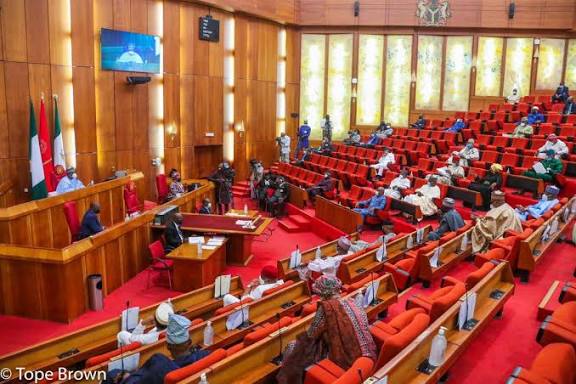

President of the Senate, Godswill Akpabio, have called on lawmakers to ensure full attendance at Wednesday’s plenary session as the National Assembly prepares for what could become one of the most consequential constitutional votes in Nigeria’s democratic history the proposed amendment to establish state police services across the federation.

Akpabio made the appeal following a growing momentum for the long-debated decentralization of Nigeria’s policing system, a reform widely advocated by security experts, governors and community leaders as a response to persistent challenges posed by insurgency, banditry, kidnapping and other violent crimes.
During an emergency plenary session of the Senate, Akpabio described the State Police Bill as a landmark piece of legislation capable of reshaping Nigeria’s security architecture and strengthening grassroots security management.
The President of the Senate stressed that constitutional amendments require broad participation by lawmakers and urged senators to view the exercise as a solemn national responsibility rather than a routine legislative duty.
He said, “Since 1960, Nigeria has not had the courage to decentralise policing, and this is the first time.
“As we struggle to become senators, let us also remember the responsibilities of being a senator. It is not enough for us to look for tickets. And when we get them, we don’t come to the chambers.”
Akpabio noted that the proposed amendment to the Constitution of the Federal Republic of Nigeria, 1999 (as amended), would create the legal framework for the establishment of state police services while providing safeguards against potential abuse through subsequent legislation and regulatory oversight.
According to him, the reform is designed to deepen community-based policing by bringing local governments, traditional institutions, village leaders, youth groups and other grassroots stakeholders into the security framework.
He argued that local communities were often better positioned to identify suspicious individuals and criminal elements operating within their environments, adding that decentralised policing would improve intelligence gathering and facilitate more proactive responses to security threats.
As part of efforts to fast-track consideration of the bill, Akpabio directed the Senate Committee on Constitution Review to submit its report by Wednesday, June 24, to enable immediate legislative action.
Amplifying the position of the President of the State, Senate Leader Senator Opeyemi Bamidele underscored the significance of lawmakers’ attendance, reminding senators that constitutional amendments can only be approved with the support of at least two-thirds of members of the chamber.
“We need a minimum of two-thirds of distinguished Senators to be able to vote on constitutional alteration. That means it is important for all of us to be here,” Bamidele said.
The Senate Leader described the state police proposal as a national issue that transcends partisan interests, regional affiliations and geopolitical considerations.
He, therefore, urged principal officers and members of the chamber to reach out to absent colleagues and ensure they participate in the historic legislative exercise.
The Senate subsequently adjourned plenary until Wednesday, June 24, 2026, at 11:00 a.m., when lawmakers are expected to debate and vote on the constitutional amendment bill.
The push for state police has gained renewed traction in recent months following President Bola Tinubu’s endorsement of the proposal and ongoing constitutional review efforts by both chambers of the National Assembly.
Proponents argue that state-controlled policing will improve local security coordination and intelligence gathering, while critics have raised concerns about the prospects and the potential abuse of the state police force.