



















By Paul Mumeh
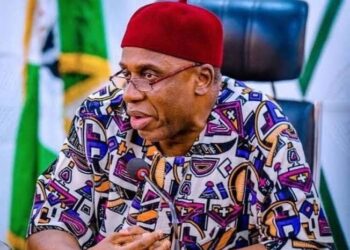
The emergence of Mr. Rotimi Chibuike Amaechi, CON, as the vice-presidential candidate of the African Democratic Congress (ADC), alongside the party’s presidential flag bearer, former Vice President Atiku Abubakar, GCON, is far more than a routine political pairing. It is a strategic declaration that the ADC intends to confront the 2027 presidential election with experience, resilience, and formidable political strength.
Amaechi is no stranger to political warfare. Over the past two decades, he has fought some of the fiercest political battles in Nigeria’s democratic history, winning many, surviving others, and emerging as one of the country’s most enduring political figures. His journey mirrors the evolution of the Fourth Republic and has firmly established him as a major force in Nigeria’s political landscape.
From serving as Speaker of the Rivers State House of Assembly between 1999 and 2007, to governing Rivers State from 2007 to 2015, and later serving as Minister of Transportation from 2015 to 2023, Amaechi has occupied some of the most strategic positions in both the legislative and executive arms of government. Few Nigerian politicians possess such a broad and varied leadership résumé.
As Speaker, he displayed exceptional legislative dexterity and political maturity. As governor, he earned a reputation for bold reforms, decisive leadership, and a readiness to make difficult decisions in pursuit of the public good. As Minister of Transportation, he championed an ambitious programme to modernise Nigeria’s railway infrastructure, reinforcing his image as a leader capable of driving large-scale national development projects.
For more than two decades, Amaechi has remained at the centre of Nigeria’s political conversation. His rise has never been accidental. It has been built on political courage, administrative competence, strategic thinking, and an unwavering commitment to public service.
Yet, distinguished credentials alone will not determine the outcome of the 2027 presidential election. Politics will.
The Atiku-Amaechi ticket enters the race at a time when the debate over power rotation has become one of the most emotionally charged issues in Nigeria’s democratic discourse.
Across much of Southern Nigeria, many believe that fairness and equity require the region to complete an eight-year presidential tenure before power returns to the North. To millions of Nigerians, zoning is more than a political arrangement; it is an unwritten covenant designed to preserve national balance, inclusion, and stability.
This is the mountain Amaechi must climb.
As arguably the most influential southern politician on the ADC ticket, he bears the enormous responsibility of persuading southern voters that the 2027 election should be decided not by geography, but by the urgent need to rescue a nation weighed down by economic hardship, worsening insecurity, unemployment, and declining public confidence in governance.
At the same time, another political reality is unfolding across Northern Nigeria.
Whether justified or not, many northern voters increasingly believe that the administration of President Bola Ahmed Tinubu has fallen short of their expectations. Rising economic hardship, persistent security challenges, and perceptions of political exclusion have fuelled growing dissatisfaction that could crystallise into a formidable electoral force in 2027.
That sentiment may well become one of the defining dynamics of the election.
If the North votes overwhelmingly for change, and if Amaechi succeeds in reducing resistance across key southern states, the ADC could engineer the biggest political upset since the 2015 coalition that ended the Peoples Democratic Party’s sixteen-year dominance of national politics.
This explains why Amaechi’s nomination is far more significant than fulfilling the constitutional requirement of selecting a running mate.
He represents a bridge between North and South.
He is the strategist expected to widen the party’s appeal across regional and political divides.
He is the field commander entrusted with expanding the ADC’s electoral map beyond its traditional support base.
His influence in the South-South, relationships across the South-East, networks in the South-West, and longstanding alliances in the North make him one of the few Nigerian politicians capable of campaigning with credibility across Nigeria’s diverse political constituencies.
Ultimately, the 2027 presidential election will be far more than a contest between political parties. It will be a national referendum on leadership, competence, equity, unity, and the future direction of the Nigerian state.
For Rotimi Chibuike Amaechi, the assignment is both historic and exacting.
His place in Nigeria’s political history is already secure. The chapter yet to be written, however, will depend on whether he can transform decades of political experience, influence, and strategic acumen into the electoral momentum capable of carrying the ADC to victory.
Should that happen, history will remember him not merely as a former Speaker, Governor, and Minister, but as the battle-tested statesman whose courage, political skill, and strategic leadership helped reshape Nigeria’s democratic journey at one of its most defining moments.
The road to Aso Rock is never won by reputation alone. It is won through persuasion, sacrifice, organisation, and the ability to inspire hope. For Amaechi, the battle has begun. Whether he ultimately emerges victorious will depend not only on the strength of his record, but on his capacity to convince Nigerians that the future they seek is worth fighting for.
** Mumeh writes from Abuja
,